Guide content
Walk into any working body shop and look at the abrasive shelf. You'll see hundreds of SKUs across grits, diameters, attachment types, and brand variants. Most of them never touch a panel.
The actual core kit — the abrasives a working tech reaches for 90% of the time — is much shorter. This guide lists those 12 abrasives by job, in roughly the order you'd use them on a typical body and paint job, with notes on grit choice, brand alternatives, and how much to keep on hand.
AutofxMart is an authorized distributor of 3M, Norton, Mirka, Sunmight, Indasa, Eagle Abrasives, and other professional abrasive brands. We'll flag where premium-tier choices justify the cost and where mid-tier alternatives are fine.
Pre-job: stripping paint and grinding welds
1. 24-grit Roloc disc (3" or 4") — paint stripping
The fastest way to take a panel down to bare metal in a localized area. Use on a die grinder or pneumatic Roloc tool. 24 grit cuts through paint, primer, and a thin layer of metal in one pass.
- Premium pick: 3M 36523 Roloc disc, 3" 24 grit
- Mid-tier: Norton or generic aluminum oxide Roloc — fine for occasional use
- When to use: localized paint removal around damage, NOT full-panel stripping (use a stripper disc instead for that)
- Quantity to stock: pack of 25, lasts most shops 3–6 months
2. 36-grit Cubitron II fibre disc (5") — weld grinding
When you've welded a panel patch in and need to grind the bead flush. 36 grit on a 5" backing plate on a body grinder is the standard. Cubitron II 987C is the best-in-class for this specific job — the precision-shaped grain stays sharper longer under high-pressure grinding.
- Premium pick: 3M Cubitron II 987C fibre disc, 5" x 7/8" arbor, 36 grit (3M PN 33454)
- Mid-tier: Norton 5" 36 grit fibre disc
- When to use: flush-grinding TIG/MIG weld beads on body panels
- Quantity to stock: pack of 10–25, depending on weld volume
→ See our 3M Auto Body Buyer's Guide for the full Cubitron II family detail.
Body filler shaping
3. 80-grit DA disc (5" or 6") — rough-shape body filler
The first sander pass on freshly cured body filler. 80 grit on a DA cuts the filler down to within ~1/16" of finish contour and reveals the high/low spots.
- Premium pick: 3M Cubitron II Hookit 80 grit, 5" or 6" (5" PN 31425, 6" PN 31497)
- Mid-tier: 3M Stikit Gold 80 grit, Norton ProSand, Mirka Gold
- When to use: initial sanding on cured body filler or All-Metal
- Stock: pack of 50, abrasives this aggressive go fast in a busy shop
4. 150-grit DA disc — block down filler
The intermediate pass. After 80 grit knocks the rough contour, switch to 150 to refine the surface before glaze putty.
- Premium pick: 3M Cubitron II Hookit 150 grit (5" PN 31427, 6" PN 31499)
- Mid-tier: 3M Stikit Gold 150 grit, Sunmight Gold 150
- When to use: mid-sand on body filler after rough shaping
- Stock: pack of 50
Pre-primer prep
5. 220-grit DA disc — primer prep
After body filler is finished, the panel needs a uniform 220-grit scratch to give primer something to bite into. This is the most-used DA grit in most shops.
- Premium pick: 3M Cubitron II Hookit 220 grit (5" PN 31428, 6" PN 31500)
- Mid-tier: 3M Stikit Gold 220, Indasa Rhynogrip 220
- When to use: scuffing prepped filler/panel before primer
- Stock: pack of 50, reorder bi-weekly in a busy shop
6. Sanding sponge (medium / fine) — contour edges
For panel edges, body lines, and detailed contours where a flat DA disc can't reach. Sanding sponges flex around shapes while still cutting.
- Premium pick: 3M Sanding Sponge, fine grit (medium-fine and fine work for most uses)
- Mid-tier: Indasa, Sunmight, Buff and Shine equivalents
- When to use: sanding around door handles, body line edges, contour transitions
- Stock: pack of 10–20
Pre-paint surfacing
7. 320-grit DA disc — primer scuff before paint
After primer cures, scuff with 320 to give the basecoat a smooth, uniform surface. Many shops also wet-sand at this stage; on dry-sand workflows, 320 DA is standard.
- Premium pick: 3M Cubitron II Hookit 320 grit (5" PN 31429, 6" PN 31501)
- Mid-tier: 3M Stikit Gold 320, Mirka Gold 320, Indasa Rhynogrip 320
- When to use: scuffing primer surface before basecoat
- Stock: pack of 50
8. 400-grit DA disc — sealer / basecoat prep
The fine prep step. After 320 (or instead of, depending on workflow), 400 grit gives the finest pre-paint surface. Many shops use 400 grit specifically for areas being sprayed sealer-only or for blending repairs.
- Premium pick: 3M Cubitron II Hookit 400 grit (5" PN 31430)
- Mid-tier: 3M Stikit Gold 400, Mirka Gold 400
- When to use: finest pre-paint surface, blending areas, sealer prep
- Stock: pack of 25–50
Wet-sanding and color-sanding (post-paint)
9. 800-grit wet/dry paper — color sand defect removal
After paint is cured, defects like dust nibs, runs, or orange peel need wet-sanding before final polish. 800 grit is the workhorse for cutting out moderate defects without going too aggressive.
- Premium pick: 3M Wetordry 800 grit (sheets or roll)
- Mid-tier: Sunmight, Norton P800 grit
- When to use: initial wet-sand on cured paint to remove defects
- Stock: 100-sheet pack or roll
10. 1500-grit wet/dry paper (or Trizact P1500) — color sand finishing
After 800 grit cuts the defect, 1500 (or 3M Trizact P1500 for orange-peel removal) refines the sanded area before machine polish. Trizact pads in foam-backed form are designed specifically for orange-peel removal without going deep.
- Premium pick: 3M Trizact P1500 (foam disc, 3" or 6")
- Mid-tier: 3M Wetordry 1500 grit sheet, Norton P1500
- When to use: finishing the wet-sand step before polish, or removing orange peel
- Stock: 25-pack of Trizact discs or 50-sheet pack of Wetordry
11. 2000-grit wet/dry paper — final wet-sand
The finest grit before machine polishing. After 1500, a 2000-grit pass leaves a surface that polishes cleanly to mirror finish with rubbing compound. Some shops skip 2000 and jump straight from 1500 to compound; depends on clearcoat hardness and the desired finish quality.
- Premium pick: 3M Wetordry 2000 grit sheet, Trizact P3000 (even finer)
- Mid-tier: Sunmight, Norton P2000
- When to use: final wet-sand for show-finish work or hard clearcoats
- Stock: 25–50 sheet pack
Polishing-pad-adjacent
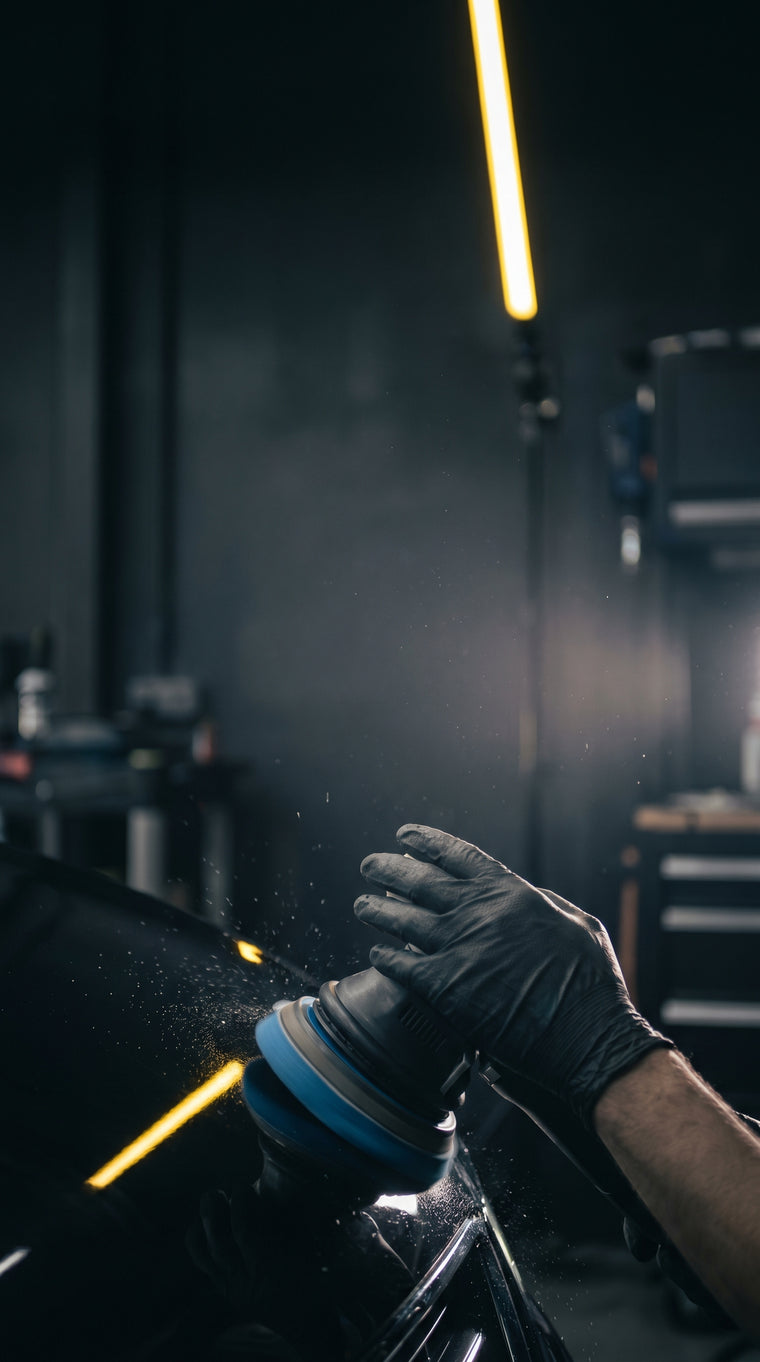
12. Wool / foam compounding pad — for the polishing step
Not strictly an abrasive, but the pad is what carries the rubbing compound and translates the abrasive action. Match the pad to your compound:
- Wool pad for aggressive rubbing compound (3M Perfect-It EX 36060) — cuts hard clearcoats fast
- Foam compounding pad for moderate compound, fewer hologram risks
-
Foam polishing pad for the polish step (3M Perfect-It Machine Polish 06064)
-
Premium pick: 3M Perfect-It wool compounding pad (8" - PN 33279) + 3M Perfect-It foam polishing pad (PN 05723)
- Mid-tier: Buff and Shine, Lake Country equivalents
- When to use: the post-paint polish workflow — wool/foam compound, then foam polish, optionally followed by foam ultrafina
- Stock: 4–6 of each type; pads outlast many discs but eventually load up
→ See our 3M Auto Body Buyer's Guide for the Perfect-It compound and polish detail.
The progression summary
For a typical small-dent collision repair, the abrasive sequence looks like:
| Step | Grit | Tool | Purpose |
|---|---|---|---|
| 1 | 24 Roloc | Die grinder | Strip paint around damage |
| 2 | 36 fibre | Grinder | Grind welds flush |
| 3 | 80 DA | 5"/6" DA | Rough-shape body filler |
| 4 | 150 DA | DA | Refine filler |
| 5 | 220 DA | DA | Pre-primer scuff |
| 6 | Sanding sponge | Hand | Edges and contours |
| 7 | 320 DA | DA | Primer scuff |
| 8 | 400 DA | DA | Final pre-paint, blend areas |
| 9 | 800 wet | Hand | Color-sand defects |
| 10 | 1500 / Trizact P1500 | Hand or foam disc | Refine wet-sand |
| 11 | 2000 wet | Hand | Final wet-sand (optional) |
| 12 | Wool/foam pad + compound | Polisher | Cut and polish |
That's the full sequence. Every step has a different abrasive type, and skipping a step usually means redoing later steps from scratch.
Premium vs mid-tier — when each is worth it
Premium (3M Cubitron II, Norton BlueFire, Mirka Iridium): - DA discs for body filler shaping (80, 150 grits) — biggest impact, abrasives wear hard in this stage - Fibre discs for weld grinding (36 grit) — Cubitron II's life advantage is real here - Wet-sand finishing (Trizact) — specialty product, no mid-tier equivalent
Mid-tier is fine (3M Stikit Gold, Indasa, Sunmight, Norton ProSand): - 220, 320, 400 grit DA discs — the abrasives wear less, premium advantage is smaller - Hand-sand papers in 800–2000 wet/dry — most papers in this range perform comparably - Sanding sponges — premium and mid-tier are essentially the same product
Avoid the lowest tier (no-name aluminum oxide, marketplace house brands): - Cuts are erratic, grit loosens off the backing, can scratch primer/clear unexpectedly - The 20–40% cost savings isn't worth the rework risk on customer cars
Where to source
AutofxMart is authorized for all the major auto-body abrasive brands:
- 3M — full Cubitron II, Stikit Gold, Trizact, Roloc lines (~1,200 SKUs)
- Norton — BlueFire, Black Ice, ProSand, fibre discs (~460 SKUs)
- Mirka — Abranet, Gold, Iridium, hand pads (~330 SKUs)
- Sunmight — Gold, Velcro sheets, masking film (~510 SKUs)
- Indasa — Rhynogrip, hand sheets, masking (~230 SKUs)
- Eagle Abrasives — wet/dry, DA discs (~230 SKUs)
Same-day shipping on all from South San Francisco for orders before 3pm PT.
Frequently asked questions
What grit sandpaper do I use after body filler?
Use 80 grit on a DA sander to rough-shape cured body filler, then 150 grit to refine, then 220 grit to prepare the surface for primer. After primer, scuff with 320 grit, optionally finish with 400 grit before basecoat application.
What's the difference between Stikit and Hookit sandpaper?
Stikit uses a pressure-sensitive adhesive backing that sticks directly to a smooth backup pad — common in older DA setups. Hookit uses a hook-and-loop (Velcro-style) backing for quick disc changes on Velcro-equipped DA pads. Hookit is more common in modern shops; Stikit is still used by techs who prefer the direct adhesion or have older equipment.
Is 3M Cubitron II worth the price premium?
For high-pressure or high-volume sanding (80–150 grit body filler shaping, weld grinding), yes — Cubitron II's 2–3x longer life and 30–50% faster cut offset the 1.5–2x per-disc price premium. For lower-pressure or finer-grit work (320, 400 DA), the advantage is smaller and standard 3M Stikit Gold or mid-tier alternatives are economically competitive.
What grit do I use to wet-sand orange peel?
3M Trizact P1500 foam discs are designed specifically for orange peel removal — they cut quickly enough to flatten texture without going so deep that you risk burning through the clear coat. After Trizact, finish with 2000 grit wet sandpaper and machine polish with Perfect-It compound and polish.
How long does a DA sanding disc last?
A premium Cubitron II 80-grit disc on body filler typically lasts 4–8 panels before noticeably losing cut. Standard 3M Stikit Gold typically 2–4 panels. Mid-tier Mirka or Indasa similar to Stikit Gold. Heat, panel hardness, and operator pressure all affect life — operators who push too hard burn through discs faster than those with lighter consistent pressure.
Can I use the same DA sander for all these grits?
Yes — most pros run one 5" or 6" DA sander with hook-and-loop backing pad, swapping discs as the workflow progresses. Some larger shops keep two DA sanders set up — one for aggressive grits (80–150), one for finer grits (220–400) — to save pad changeover time. For DIY setup, a single DA is plenty.
What about powered net abrasives (Mirka Abranet, 3M Cubitron net)?
Net-style abrasives integrate with dust-extraction systems — the holes in the disc pull dust through the backing pad into a shop vac, dramatically reducing airborne dust. Excellent for ceramic-clearcoat work where dust contamination must be controlled. Adds equipment cost (vacuum-compatible backing pad + shop vac) but improves finish quality and shop air quality. Recommended for shops doing high-end refinish work; optional otherwise.
Bottom line
Twelve abrasives, used in roughly the order above, cover ~95% of the actual sanding work in a body shop. The remaining 5% is specialty (custom grits for very specific surfaces, exotic specialty pads for show-finish polishing) and you'll add those as specific jobs demand them.
If you're stocking a new shop or rebuilding a depleted abrasive shelf, work from this list — buy the premium tier for the high-pressure DA grits (80, 150) and the wet-sand finishing pads (Trizact), and the mid-tier for the rest. That's the configuration most working shops converge on.
Samer Dwaikat is the founder of AutofxMart, an authorized distributor of 3M, Norton, Mirka, Sunmight, Indasa, and other professional abrasive brands. AutofxMart ships same-day from South San Francisco, California. Questions: support@autofxmart.com, (415) 798-6167.
Shop abrasives at AutofxMart → Read: The 3M Auto Body Buyer's Guide → Read: Small Body Shop Supply Checklist →