Transtar Autobody Technology
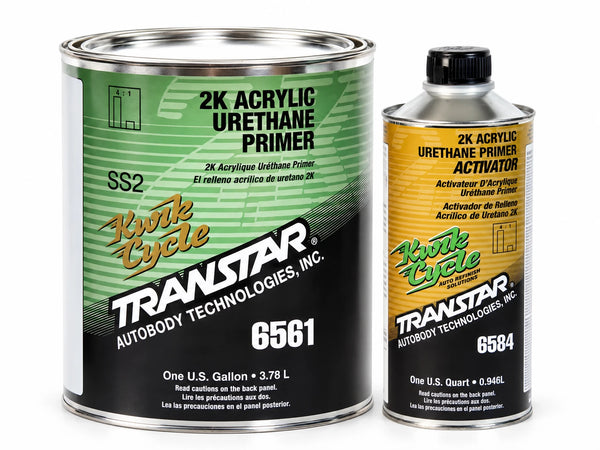
Transtar 6561 2K Primer Kit- Gray Gallon
- 6584 Activator Quart
$199.00$284.21 separately

Pro-grade collision, refinish and detailing supply from the brands your bay already runs, shipped within 2 business days.
No business account needed. Prices in CAD, Standard Ground in 2-7 business days, duties and taxes collected on delivery. Paint and aerosols ship in the U.S. only.
The pairs shops buy together at our counter (clear and activator, primer and activator) packed on our South San Francisco shelf and shipped as one order.
Departments routing straight to the line you need.
A short list of fast-moving paint, body and finishing gear.
 Save 32%
 Save 31%
 Save 28%
 Save 30%

 Save 14%
 Save 30%
 Save 30%
 Save 3%
 Save 14%
Pick your project, order the full system, ask us when you're stuck.
Short, straight tutorials from the counter that mixes your paint: where your paint code is, how to hold a spray can, 1K or 2K clear, filler or glaze. New ones as the series grows.
 9:47
How to blend car paint so the repair disappears, in six levels, from your first blend to a tri-coat. The short version: colour to hiding over the repair, each coat a little further out than the last at a few psi less, then clear over the whole panel, edge to edge. Every number here is from the paint makers' own pages (AkzoNobel, Axalta, PPG, Spies Hecker, Standox, Ford), and where they disagree, we say so.
 0:30
Right paint code, fresh paint, and you can still see where the repair stops? That line is the edge of the new colour. Blend it: colour to hiding over the repair, each coat a little further out than the last, a few psi lower every coat, then clear over the whole panel, edge to edge. Never stop the clear in the middle of a panel.
 3:24
Same 2K clear, two clocks. Baked in a booth at 140°F: 30–40 minutes, and once it's cooled you can tape, cut and buff. Air-dried in a garage at about 70°F: tape after about 16 hours, cut and buff after a day, full cure in about a week. AutofxMart's free Cure & Bake Schedule gives the flash, recoat, tape, cut-and-buff and full-cure times for seven coatings, air-dry, force-dry or infrared.
 6:20
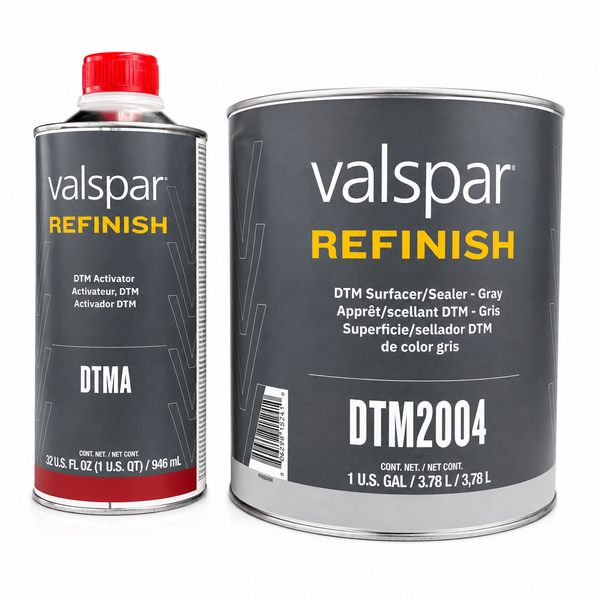
DTM primer sealer: Valspar's DTM2004 is a direct-to-metal primer — onto steel, aluminum or galvanized, properly cleaned and sanded — and the same can is the sealer. The gallon's own label says "DTM Surfacer/Sealer". Valspar's data sheet settles it with one digit: 4:1:1 by volume (4 parts DTM2004, 1 part DTMA activator, 1 part reducer) is the primer surfacer; 4:1:2 is the primer sealer. That one extra part of reducer changes everything after it: 1 to 3 medium wet coats become 1 to 2, flash drops from 10–15 minutes to 5–10, solids by volume go from 40–50% to 30–40%, and only the sealer can be topcoated without sanding, 8 hours max.
 0:35
Primer or sealer? Valspar's DTM2004 is both, and its label says so: DTM Surfacer/Sealer. Valspar's own data sheet: 4:1:1 by volume is the primer surfacer; 4:1:2, one more part of reducer, is the sealer. Let the sealer flash dull 5–10 minutes between coats, and topcoat in 20–30 minutes with no sanding for up to 8 hours.
3M, SEM, House of Kolor and more.


Cookies
Choose what AutofxMart is allowed to store on this device. Your choice is saved per browser and you can change it at any time from the cookie button in the corner of any page. Every cookie is named and explained in our Cookie Policy.
Cart, checkout, sign-in, fraud prevention and this cookie choice itself. The store cannot function without them, so they cannot be switched off.
Aggregate page and traffic data, so we can see which catalogue pages and searches get used and fix the ones that do not work.
Lets us measure our advertising and show products you looked at on other sites, instead of paying to show them to everyone.
Remembers preferences such as light or dark mode, recently viewed SKUs and the filters you last used on a collection.
Some advertising cookies count as a "sale" or "share" under CPRA and similar state laws. Switch this off to opt out of that.