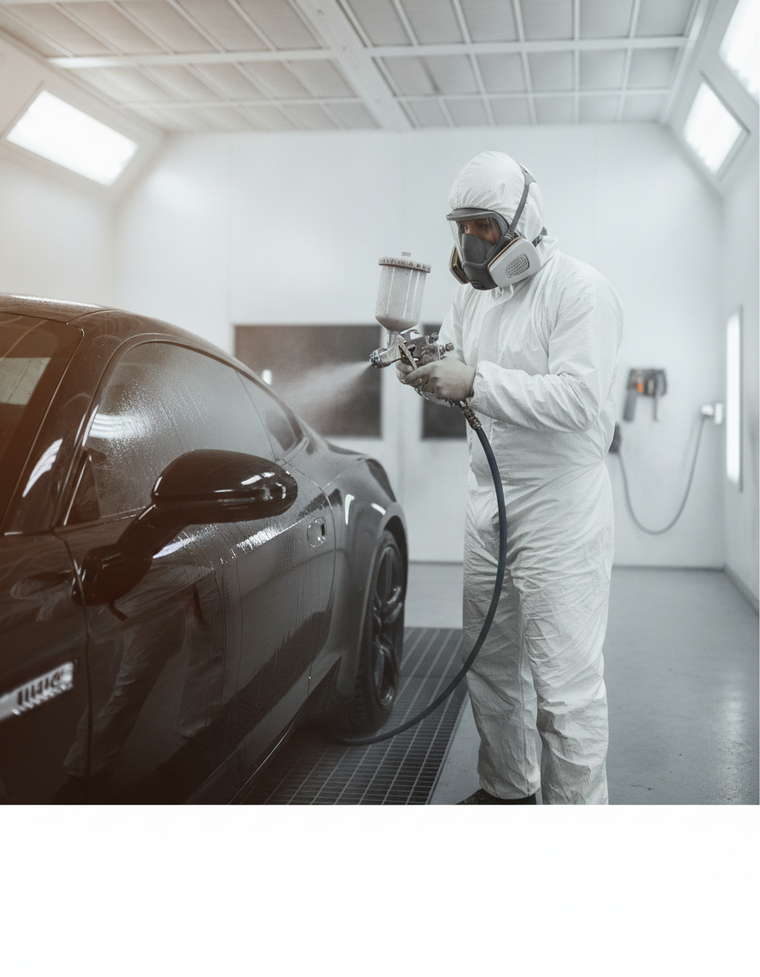
Stop Repainting Twice: The Spray-Out Card Rule Every Painter Should Know
The spray-out card rule: same code, right formula, and the colour is still wrong on the car. It's nearly always one of four things: the light you judged it under, the angle you judged it from, the variant you picked, or a spray-out card that didn't copy the job. Here's how a colour match actually works, from the lamp to the last tint, and the one habit that saves every repaint: spray a card first, and spray it like the job.
Judge under daylight (about 6,500 K, CRI 95 or more, R9 90 or more), then check under a halogen and a shop LED. Two real formulas from the shop's own toner data match under daylight and part by a ΔE of 6 under a halogen: that's metamerism, and why you tint only with the formula's toners. A metallic is two colours, face and flop; a typical silver drops from L* 127 at 15° to 38 at 110°. Pick the variant before you tint. Spray the card with the formula's sealer shade, the job's gun, distance and flash: wet reads darker, dry reads lighter. One coat of a translucent red over white and over black is a ΔE of 10. Describe the car against the paint in order: lightness, chroma, hue, flake, flop. A tint hit is 10% of that toner's weight in the batch. Never white to lighten a metallic's face. Tint to blend, not to perfect, and record the formula with the VIN.
NEXT ON THIS CHANNEL
What grit after body filler? Every hand-off, 80 to 3000. Then: bare metal, etch or epoxy primer? Subscribe so you don't miss them.
In this video
- 0:00 Same code, wrong colour
- 0:33 1 · The light: judge at 6,500 K
- 1:20 2 · Metamerism: two formulas, one colour
- 1:59 3 · Your eye: glance, don't stare
- 2:28 4 · Angle: face, flop and two panels
- 3:14 5 · The variant, before any tinting
- 3:42 The spectro: the car is the standard
- 4:07 6 · The spray-out card, sprayed like the job
- 4:54 7 · Undercoat: one coat, two colours
- 5:24 8 · Describe it: L, C, H, flake, flop
- 6:03 9 · Tinting: one change, one card, one look
- 6:48 10 · Metallics: never white, flop first
- 7:20 11 · Blend, don't chase
- 7:52 Six ways a match fails
- 8:25 Your colour, mixed to the code
- 8:55 Next: the grit sequence, the primers
Shop what's in the video
Good to know
- Every number in this video comes from the shop's own colour-match training guide, built from an OEM colour-match class and the measured data behind it; your paint system's technical data sheets, mixing scheme and safety data sheet come first. Every product page links its SDS
- The two formulas shown are computed from measured toners (a Kubelka–Munk model), not sprayed; the ΔE values are computed, and we say so.
- The fender, the lamp and the two panels are 3D renders, labelled on screen; the spray passes, the red over white and black, the chips, the blend and the hand-at-the-car shots are AI-generated video (Kling 3.0 through Higgsfield), labelled on screen; the spectro and the scale are our own counter footage. The products shown are real products from our store, and AutofxMart sells them.
- The spray gun in the renders is a 3D scan, "Harbor Freight spray gun" by DtommyD on Sketchfab, CC BY 4.0, cleaned and refitted
- Wear the respirator. Basecoat and clear carry isocyanates and solvents: read the SDS before you spray a card or a car.
- Blocked flat and primed? Find your paint, mixed to your car's code
Transcript
Same code, wrong colour Same code, right formula, and the colour is still wrong. It's nearly always one of four things: the light you judged it under, the angle you judged it from, the variant you picked, or a spray-out card that didn't copy the job. Here's how a colour match actually works, from the lamp to the last tint, and the one habit that saves every repaint: spray a card first, and spray it like the job. Paint mixed to your code, the cards, and the lights to check it under are at autofxmart.com, link below.
1 · The light: judge at 6,500 K Watch the cards. Under a warm bulb at twenty-seven hundred kelvin everything leans orange and the red looks hotter. At sixty-five hundred, daylight, the grey card is truly grey. Your eye adapts to both and calls them normal. A camera doesn't, and neither does the customer's driveway. So judge under daylight: about sixty-five hundred kelvin, a colour rendering index of ninety-five or more, and an R-nine, the saturated-red score, of ninety or more. A halogen scores a hundred and is still not daylight: CRI compares a lamp with a reference of its own colour. Then check under two more: a warm halogen work light, and a four-thousand-kelvin shop LED. One light at a time, grey all around it.
2 · Metamerism: two formulas, one colour These two cards are two real formulas, computed from the shop's measured toners. The first is the factory kind of recipe: white, black and two iron oxides. The second reaches the same colour with organic toners. Under the booth's daylight lamp they are identical. Switch to a halogen work light and they part, by a delta-E of six. That is metamerism: the same colour under one light, two colours under another, because different pigments are behind it. It's why you tint only with toners that are already in the formula, and why you check under three lights before you call it a match.
3 · Your eye: glance, don't stare Your eye is the instrument, and it tires. Stare at a red panel and the cones that see red turn their gain down, so the next red looks greener and weaker than it is. Glance, three to five seconds, then rest on grey. The first look counts. The second is never as honest. Neutral clothes, grey walls, no tinted glasses. And test everyone: about eight percent of men have a red-green deficiency, and most of them don't know it.
4 · Angle: face, flop and two panels A solid colour looks the same from every angle. A metallic doesn't. Next to the reflection of the light it's bright and shows its flake: the face. Away from the reflection it goes darker: the flop, the side tone. The trade puts a number on that travel, the flop index. Zero is a solid; most two-stage metallics sit between five and eighteen. In the shop's library of forty-two thousand measured standards, a typical silver drops from an L-star of one twenty-seven at fifteen degrees to thirty-eight at a hundred and ten. So a door and a quarter panel in the same paint can read as two colours when they sit a few degrees apart. Before you call it a mismatch, compare your spray-out in the plane of each panel.
5 · The variant, before any tinting Factories don't paint every car of one code alike. Plants and years drift, so the paint makers publish variants: lighter, darker, bluer, coarser. Picking the right one is worth more than any amount of tinting. With chips: polish a spot on the panel you'll blend into, hold the chip in the plane of the panel, touching it, in daylight, face and flop. Rank the closest two or three, then spray those. A chip is not a spray-out.
The spectro: the car is the standard With a spectrophotometer: calibrate it, read a flat polished spot near the repair, three reads or more, averaged, and let the software rank the variants. Then read its numbers the right way round. A spectro reports sample minus standard. Make the car the standard, and every sign describes your spray-out: plus L, the card is lighter; minus b, the card is bluer.
6 · The spray-out card, sprayed like the job Wet paint in a cup tells you almost nothing. The spray-out card is the only honest preview, if it is sprayed exactly like the job. Start with the sealer, in the formula's value shade, on the card too. Same gun, same tip, same air, same distance, same flash. Watch the flakes. A wetter coat gives them time to lie flat, and the colour reads darker straight on. A drier coat freezes them at angles, and it reads lighter. That is as big a move as a toner hit, which is why the card and the job are sprayed the same way. Spray until the hide band disappears, and count the coats. Clear it, at least half the card, with the job's coats. Dry it, let it cool, label the back, and judge it against the polished panel, in its plane, under three lights.
7 · Undercoat: one coat, two colours Most bright reds, yellows and oranges, and nearly every pearl, don't hide in the normal number of coats. Light goes through the colour, hits the sealer, and comes back. One coat of this red over white and over black is two different colours: a delta-E of ten. It takes about four coats before the ground stops mattering. So the sealer shade comes from the formula, not from habit, and the card gets the same shade and the same count of coats as the car.
8 · Describe it: L, C, H, flake, flop You can only fix what you can name, and always the same way round: the car compared to the paint. Lightness first: is the car lighter or darker? Then chroma: cleaner and richer, or dirtier, greyer, chalkier? Then hue: redder, yellower, greener or bluer. A red can only lean yellower or bluer; a blue, greener or redder. Only the neutrals can go any way. For a metallic, two more. Is the flake finer or coarser? And is the side tone lighter or darker? That order matters, because each fix disturbs the next one. And drop the words that cause tint mistakes: brighter, duller, warmer. Say the attribute.
9 · Tinting: one change, one card, one look Before you tint, check the four things again: code, variant, sealer shade, and a card sprayed like the job. Most tint jobs are one of those. Then tint only with toners already in the formula. A new toner is a new metamerism. One change at a time, in small hits. A hit is ten percent of that toner's actual weight in your batch. A two-hundred-and-fifty-gram batch with forty grams of blue: a hit of blue is four grams, and you start smaller with a strong toner. Weigh it, write it down, stir it, spray another card. Never judge in the cup or on the stick. Three rounds and no closer? Stop tinting. The problem is upstream: the code, the variant, the sealer, or the technique.
10 · Metallics: never white, flop first Metallics have one rule above the rest: never add white to lighten the face. White scatters light. It makes the face darker and milky, lightens the flop and shrinks the flake. To lighten the face, add the formula's aluminium, or take out some black. To lighten the flop: a fine white mica, or your system's flop-control additive, within its limit. To darken it: black, or a coarser aluminium. And fix the flop first. A side-tone mismatch is the hardest thing to hide in a blend.
11 · Blend, don't chase A perfect panel match is rare and expensive. The goal is a blendable match: the flop and the lightness match, and what's left is small, a delta-E of about one to two at each angle, and it looks right under all three lights. Then stop tinting, and let the blend into the next panel hide the rest. Save the final formula with every tint, the variant, the sealer shade, the coats, the gun and the VIN. The same car, or the next one from that plant, becomes a one-pour job.
Six ways a match fails Six ways a match fails. Judged under one light: the booth lamp said yes, the driveway said no. White to lighten a metallic: a darker, milky face and a smaller flake. A card sprayed differently from the job: wetter or drier, the flakes moved, and so did the colour. The wrong sealer shade: a translucent colour shows it, most of all in the flop. A toner that wasn't in the formula: a new metamerism, built in. And chasing a perfect panel. Tint to blend, then blend.
Your colour, mixed to the code The paint is the easy part. Type your code into the paint finder at autofxmart.com and it's mixed to the code, in an aerosol, a quart, a half gallon or a gallon. The cards are there too: metal spray-out cards in the value shades, and a handheld colour-match light, so you can check face and flop on the car itself. Every product page links its safety data sheet, and your paint system's own data sheets and mixing scheme come first.
Next: the grit sequence, the primers Spray a card first, spray it like the job, and judge it under three lights. Your colour, mixed to your code, is at autofxmart.com. Which variant fooled you? Tell us in the comments. Next on this channel: what grit after body filler, every hand-off from 80 to 3000, and bare metal: etch or epoxy primer? Subscribe so you don't miss them.
AutofxMart: paint mixed to the code and body shop supplies, shipped from South San Francisco. Video by Upshift.